
Skip to content

A personal initiative of Laurence Liew · Author of AI-First Nation

The AIRI Framework

Measure. Act. Transform.

The AIRI Framework provides a comprehensive, evidence-based system for measuring and developing AI readiness — at both individual and organisational levels. Built on 8+ years of real-world AI transformation experience, it uses behavioural anchors with measurable evidence, not self-assessed attitudes.

Organisations engaged
1,000+
AI projects completed
300+
Professionals reached
300K+
Framework version
v3.2

The target distribution.Most individuals and organisations should target L2 — AI Ready (Practitioner). Maturity level should be driven by business objectives — an organisation at L2 with strong governance and clear ROI is better positioned than one at L3 with governance gaps.

L0
L1
L2 – AI Ready
L3
L4
~5%
~10%
~50%
~30%
~5%

Two assessments, one architecture

Personal and organisational readiness, measured together.

Individually, each assessment provides actionable insights. Together, they reveal critical alignment gaps between workforce readiness and organisational capability. We call this The AIRI Framework or just AIRI for short.

For Organisations

oAIRI

Organisational AI Readiness Index

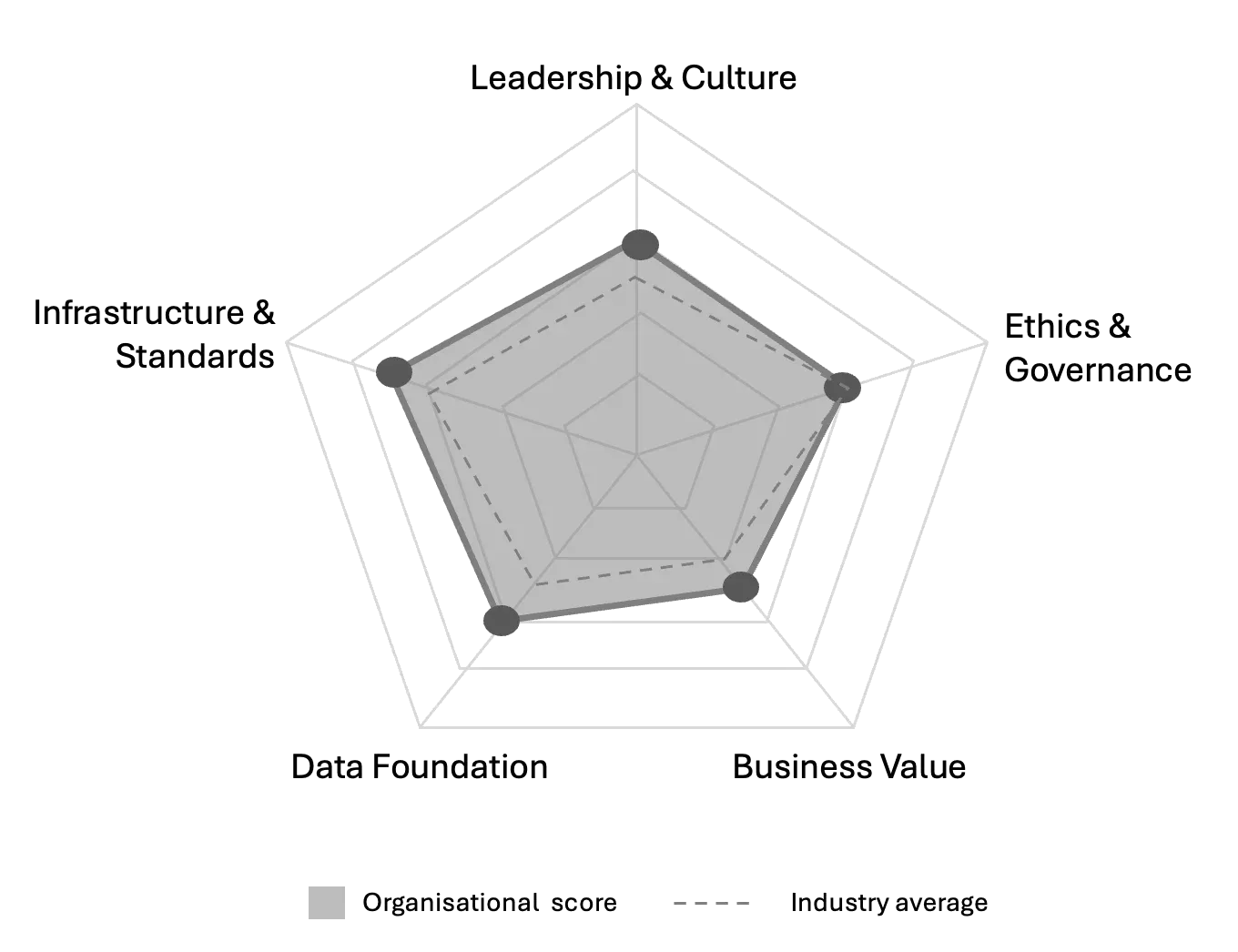
Measures your organisation’s AI readiness across leadership, culture, governance, data readiness, and infrastructure. Used by governments, industry associations, and enterprises to benchmark capability and target interventions.

20 minutes · 15 questions · Free

Learn about oAIRI →

For Individuals

pAIRI

Personal AI Readiness Index

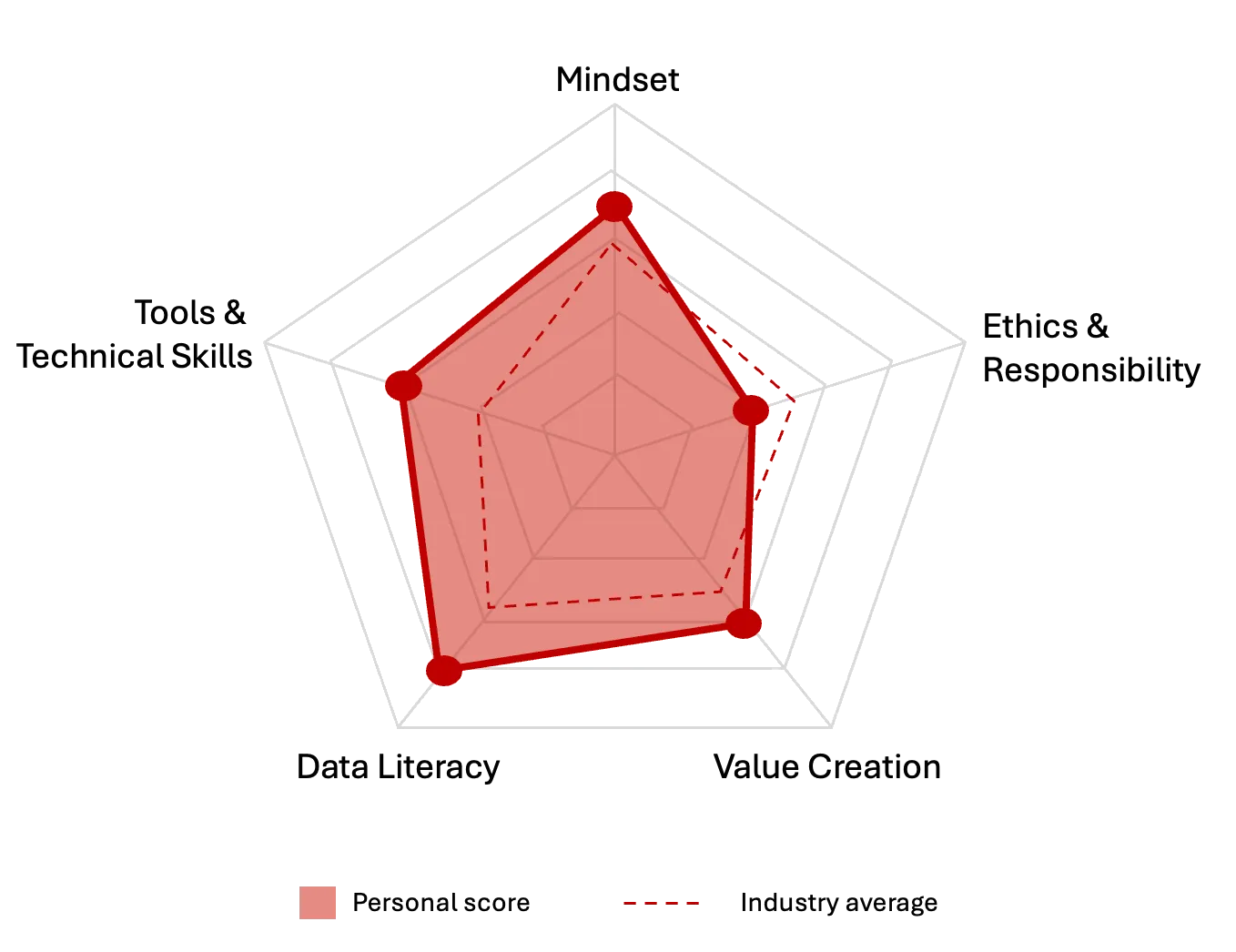
Measures your individual AI readiness across mindset, ethics awareness, value creation, data literacy, and tools. The same proven framework, now applied to the individual. pAIRI scores feed directly into your organisation’s oAIRI scores.

20 minutes · 15 questions · Free

Learn about pAIRI →

Shared architecture

Five pillars, fifteen dimensions, five levels

Each dimension maps to one question in each assessment. The oAIRI name shows the organisational perspective, the pAIRI name the individual. Same architecture, different lens — 15 questions, about 20 minutes per assessment.

P1

Leadership & Culture

pAIRI · Mindset

Is there commitment and capability to succeed?

  • D1Management Support

    Understanding AI

  • D2AI Literacy

    Learning Agility

  • D3AI Talent

    Role Positioning

  • D4Workforce Adaptation

    Delegation Disposition

  • D5Experimentation Culture

    Initiative & Experimentation

P2

Ethics & Governance

pAIRI · Ethics & Responsibility

Are risks managed and ethics considered?

  • D6AI Governance

    Ethics Awareness

  • D7AI Risk Control

    Risk Awareness

  • D8GenAI & Agent Risk Management

    GenAI Critical Thinking

P3

Business Value

pAIRI · Value Creation

Can value be identified and captured?

  • D9Business Use Case

    Use Case Identification

  • D10GenAI Value Realisation

    GenAI Productivity

P4

Data Foundation

pAIRI · Data Literacy

Is data accessible and of sufficient quality?

  • D11Data Quality

    Data Evaluation

  • D12Reference Data

    Data Proficiency

P5

Infrastructure & Standards

pAIRI · Tools & Technical Skills

Are tools, infrastructure, and standards in place?

  • D13AI/ML/Data Infrastructure

    Tool & Agent Proficiency

  • D14Specification Standards & Practices

    Specification Thinking

  • D15GenAI & Agent Deployment

    AI-Assisted Creation & Orchestration

Five pillars, fifteen dimensions, one shared architecture — the organisational and personal lenses on the same readiness model.

Five maturity levels

Five levels. One clear target.

Both assessments map to the same five maturity levels. The AIRI Framework defines Level 2 (Practitioner) as the success target — for individuals and organisations alike. You don’t need to become an AI expert; you need to use AI effectively.

L0

AI Unaware BYSTANDER

Range: 0.00 – 0.99 · Anchor point: 0.00

Haven't started — and that's okay. Everyone starts here.

No meaningful AI engagement. Whether it's an individual who hasn't tried AI tools or an organisation with no AI strategy — everyone starts here. The key message: awareness is the first step, and starting now is what matters.

L1

AI Aware EXPLORER

Range: 1.00 – 1.99 · Anchor point: 1.25

Knows AI exists but not yet using it consistently.

Aware of AI's potential and actively exploring. For an individual, this means experimenting with AI tools and building foundational understanding. For an organisation, it means leadership sees the opportunity and initial pilots are underway. Curiosity is high but systematic adoption hasn't started.

L2

AI Ready PRACTITIONER

Range: 2.00 – 2.99 · Anchor point: 2.50

Success target

Uses AI effectively in work with measurable impact.

AI is actively used with measurable results. For individuals, this means effective daily use of AI tools with clear impact on productivity. For organisations, it means deployed solutions with governance in place. This is where the strategic question shifts from "what can we automate?" to "how should we restructure work?" Practitioner is the goal for most people and most organisations. You don’t need to reach L4.

L3

AI Competent BUILDER

Range: 3.00 – 3.99 · Anchor point: 3.75

Beyond automation: actively restructuring how work gets done.

Beyond automation: actively building AI capabilities and restructuring how work gets done. Individuals at this level lead AI initiatives, mentor others, and build solutions. Organisations have dedicated AI teams, formal ethics processes, and transformation roadmaps. The focus shifts from adopting AI to reshaping work around it.

L4

AI Catalyst PIONEER

Range: 4.00 – 5.00 · Anchor point: 5.00

AI agents handle production; humans provide judgement.

Driving AI transformation at scale. AI agents handle routine production; humans provide judgement, strategy, and oversight. Individuals at this level architect AI ecosystems and influence industry standards. Organisations have mature governance at board level and continuous innovation embedded in operations.

Scoring

How scores are calculated

Each question uses behavioural anchors — descriptions of observable behaviour, not opinions. You pick the one that honestly matches where you are today. Each anchor maps to a fixed score, and pillar scores are simple averages of their questions.

P1 = (D1 + D2 + D3 + D4 + D5) / 5
P2 = (D6 + D7 + D8) / 3
P3 = (D9 + D10) / 2
P4 = (D11 + D12) / 2
P5 = (D13 + D14 + D15) / 3

Overall = (D1 + D2 + … + D15) / 15

Overall Level = min( band(Overall), band(P2) )

The overall score weights all questions equally — not pillar averages. P1 (5 questions) naturally carries more weight than P3 or P4 (2 questions each).

Worked examples — v3.2 level gating

Your overall level can never exceed your P2 level — your maturity cannot outgrow your ethics. P2 at L0 caps you at L0 (STOP), P2 at L1 caps you at L1 (CONDITIONS), P2 at L2+ lifts the cap (GO) — the same three gate states as the Decision Engine.

pAIRI · individual

15 answers totalling 28.75 → 28.75 / 15 = 1.92 → band L1. P2 pillar = 1.67 → L1. min(L1, L1) →L1 — AI Aware.

oAIRI · leadership workshop

Question-weighted mean ≈ 1.29 → band L1. P2 pillar = 0.80 → L0 → STOP. min(L1, L0) → L0 — AI Unaware — build the ethics foundation first.

oAIRI · strong org, thin ethics

Mean = 2.60 → band L2. P2 pillar = 1.50 → L1 → CONDITIONS. min(L2, L1) → L1 — AI Aware — capped from L2.

Combined use reveals the gaps

If your workforce’s average pAIRI is L2 but organisational Data Foundation (P4) is at L0, individual skills are running ahead of organisational infrastructure. This gap analysis is the foundation of effective AI transformation planning.

From assessment to action

Assess. Act. Transform.

  1. Assess

    Take pAIRI or oAIRI

    15 questions, ~20 minutes. Teaching content between pillar groups — you learn while you assess.

  2. Act

    Close your gaps

    Your lowest pillars are your roadmap. The behavioural anchors at the next level describe, in observable behaviour, exactly what that level looks like — that is what you work toward.

  3. Transform

    Track & grow

    Reassess every 3–6 months to track growth. oAIRI guides project prioritisation through the Decision Engine.

The automation → transformation inflection

Level 2 marks the pivotal shift from “what can we automate?” to “how should we restructure work around AI?” If you’re using AI to speed up existing workflows, that’s automation. If you’ve eliminated a workflow entirely because AI handles it end-to-end with human oversight at checkpoints, that’s transformation. Both are valuable — the framework helps you know which stage you’re in.

Why this framework

Built on experience. Not theory.

Behavioural anchors, not self-assessment

Every response option describes observable, measurable behaviour — not opinions or self-ratings. This prevents grade inflation and the Dunning-Kruger effect.

Real-world backed

Developed from AI Singapore’s national programmes reaching 300,000+ professionals, 1,000+ organisations and deploying more than 300 real-world AI projects. Not theoretical — built from patterns observed in real AI adoption.

Learn during assessment

The assessment itself is a learning experience. Educational content between question groups means every participant leaves knowing more than when they started.

Agent-era current

Version 3.2 adds the ethics level gate — your overall level is capped at your P2 level. Version 3.1 brought AI agent delegation proficiency, specification thinking, and trust calibration — reflecting how AI is actually used today.

Get the complete framework

Start with an honest measurement.

Download the full framework document — 15 dimensions, scoring methodology, and behavioural anchors for both oAIRI and pAIRI, released under Creative Commons CC BY 4.0. Sign up and we’ll email you the download links.