AIRI Discovery & Prioritisation
You measured your AI readiness. Now what?
The AIRI Decision Engine takes your organisation from scores to action, identifying, evaluating, and ranking your top AI projects in a single 40-minute workshop.
Eighty-five to eighty-seven per cent of AI projects fail, not because the technology fails, but because organisations pick the wrong projects, underestimate change management, or lack data readiness. The Decision Engine exists to fix that.
Pipeline
The 3-step pipeline
Data driven, not ego. The Decision Engine replaces subjective debates with a single transparent formula that weights what actually matters in AI project success:
-
1
Discover
Gut feel · 2×2 matrix
-
2
Score & decide
5-pillar scoring · AIRI DE formula
-
3
Prioritise
Strategic judgement · Dot voting
Step 1 · Discovery matrix
Start with discovery
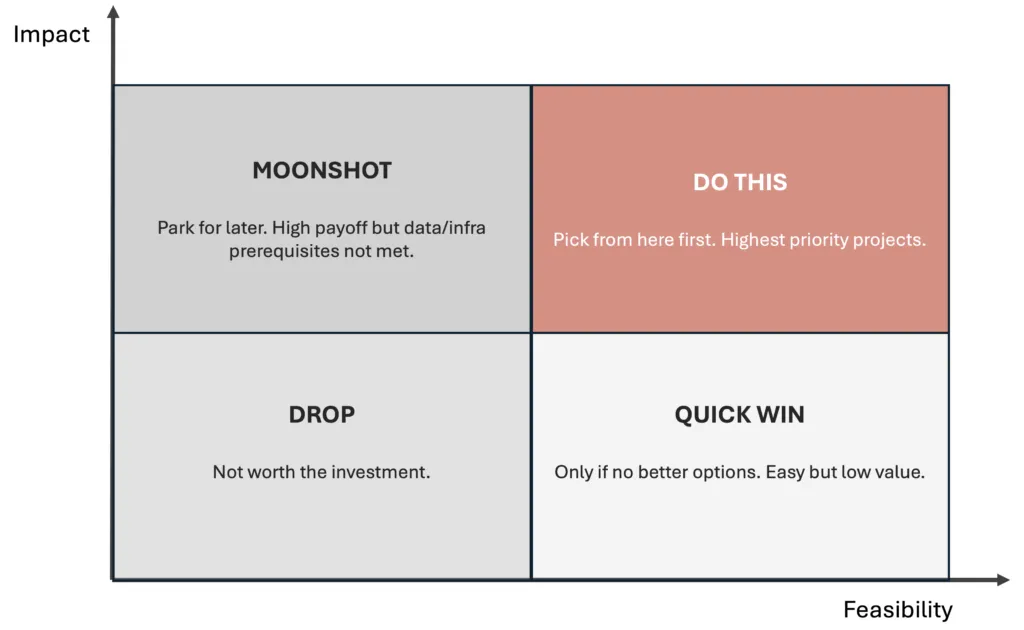
Before scoring anything, teams brainstorm real pain points and place project ideas on a simple 2×2 Impact × Feasibility matrix. This is a 1-minute gut-feel exercise. No rubrics, no arithmetic. Selection rule: each team picks 2 from Do This. If fewer than 2, pull from Moonshot first, Quick Win second. Never from Drop.
Step 2 · The AIRI Decision Engine
One formula, five pillars, complete clarity.
AIRI Decision Engine score
[(0.7×P4 + 0.3×P5) + P3 + 2×P1] × P2 Ethics Gate
2×
P1 · Leadership & Culture
Leadership, talent, and change capacity. Double-weighted because people are what make or break AI projects.
1×
P3 · Business Value
Strength of the business case. Important, but a great business case without org readiness still fails.
0.7 + 0.3
P4 · Data + P5 · Infra
Data dominates infrastructure. You can spin up cloud compute; you cannot conjure clean data.
Gate
P2 · Ethics & Governance
Not a score to optimise. It is a gate. No governance? Full stop. The formula multiplies by zero.
The ethics gate
Ethics is not optional. It is a multiplier.
P2 adds nothing to the score. It multiplies the entire result. An organisation with no ethics framework gets zero, regardless of how strong everything else is.
×0
Stop
P2 at L0 (AI Unaware). No governance framework. Do not proceed. Build the ethics foundation first.
×0.5
Conditions
P2 at L1 (AI Aware). Basic awareness but no formal framework. Proceed with an ethics remediation plan. Score is halved.
×1
Go
P2 at L2+ (AI Ready or above). Adequate governance and risk framework in place. Full score applies.
The same gate runs the assessments themselves: your pAIRI and oAIRI overall levels are capped at your P2 level (STOP, CONDITIONS, GO). One ladder, one gate.
See it in action
Worked example
A mid-sized company evaluates deploying an AI chatbot to handle tier-1 customer queries.
- 1. Feasibility: (0.7 × 2.50) + (0.3 × 3.75) = 2.875
- 2. + Business Value: 2.875 + 3.75 = 6.625
- 3. + 2× Leadership & Culture: 6.625 + (2 × 2.50) = 11.625
- 4. × Ethics Gate: 11.625 × 1 = 11.625
- AIRI Decision Engine Score = 11.6 / 20 = 58%
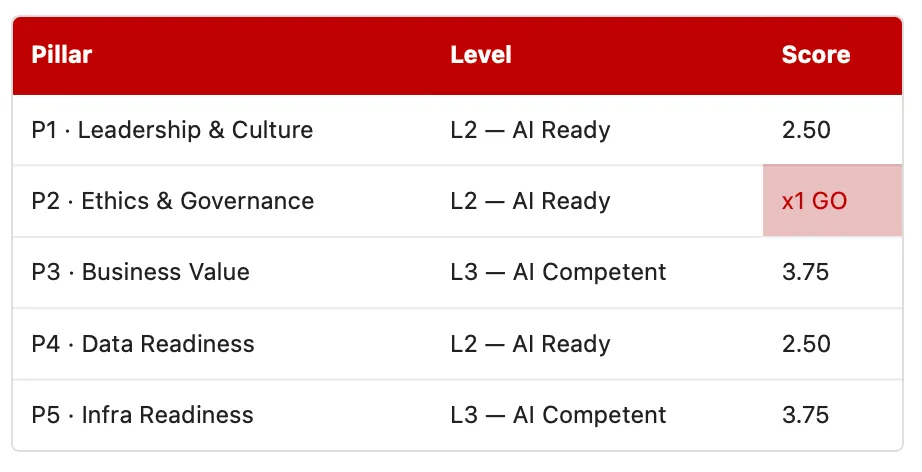
A moderate candidate. Proceed with caution on weak pillars. P4 (Data Foundation at L2) is the bottleneck. Improving data access would push the score significantly higher.
Reading the score
What the AIRI Decision Engine tells you
The theoretical maximum is 20. How to interpret where a project lands:
- 0
- Ethics-killed
- <25%
- Very low. Drop.
- 25–50%
- Weak. Significant gaps.
- 50–75%
- Moderate. Go! But watch out for weak pillars.
- 75–100%
- Strong. High confidence! Prioritise and resource.
“It is not a rejection. It is a roadmap.”
Step 3 · Strategic judgement
Prioritise. The team decides what to champion.
After each team’s picks are scored and presented, every participant votes silently across three strategic lenses. No discussion, no lobbying, just stickers on worksheets mounted on the wall. This is deliberate. The Decision Engine removes politics from evaluation. The dot vote adds back strategic intent, what leadership actually wants to invest in, knowing the readiness data. Rules: 2 stickers per round per person. Both stickers on one project = OK (signals conviction). No tallying between rounds. Anchoring on the leader biases subsequent votes. Count everything at the end.
Impact
Would this transform our organisation in 3 years?
Readiness
Can we start meaningful progress within 90 days?
Collaboration
Would other organisations also benefit from this?
Tiebreakers: highest Impact count → highest DE Score → 3-minute discussion + show of hands.
Get started
Ready to find your top 3 AI projects?
Download the complete workshop materials, runbook, A1 worksheets, and facilitator scripts.