Skip to content

Organisational AI Readiness Index

How AI ready is your organisation?

A 15-question assessment designed for leadership teams. Score it together as a group for a shared view, or answer individually; both work. The Organisational AI Readiness Index (oAIRI) reveals where your organisation stands across the five pillars of AI readiness, and feeds directly into the AIRI Decision Engine for project prioritisation.

oAIRI logo

Architecture

The five organisational AIRI pillars

oAIRI uses the same 5-pillar architecture as pAIRI but asks about organisational capabilities. The assessment is designed for leadership consensus. Discuss each question as a team and agree on the level that best describes your organisation today.

P1 – Leadership & Culture

5 questions

Measures leadership commitment, workforce capability, and organisational culture for AI adoption. Five dimensions cover leadership support, workforce literacy, change management, structural adaptation, and experimentation culture, the people and culture foundations that determine whether technical AI investments succeed or fail.

D1

Management Support

How actively does your senior management support AI initiatives?

Leadership commitment is the strongest predictor of AI programme success. Without budget, sponsorship and strategic priority from the top, AI initiatives stay grassroots experiments that fade when the enthusiasm does. This question measures where your senior management stands, from no engagement to board-level strategic priority.

D2

AI Literacy

What is the level of AI understanding across your organisation?

Whether AI tools get adopted or ignored depends on the wider workforce understanding what AI can do; a small AI team cannot transform an organisation where everyone else is unsure. This question measures how far AI understanding and training have spread. The percentage thresholds in the options keep the answer measurable rather than anecdotal.

D3

AI Talent

What AI talent does your organisation have?

AI Literacy (question 2) is about everyone; this question is about specialists, the people whose job is to build, deploy and maintain AI systems. We measure the depth of dedicated AI talent, from no AI roles at all through to a full in-house centre of excellence.

D4

Workforce Adaptation

How is your organisation adapting its workforce structure for AI?

Hiring AI Talent (question 3) is not enough; the existing workforce has to adapt too. AI takes over coordination-heavy work and amplifies human judgement, so roles and team structures will change whether you plan for it or not. This question measures whether your organisation is redesigning roles deliberately, or waiting to be disrupted.

D5

Experimentation Culture

How does your organisation approach AI experimentation?

Adopting AI requires structured experimentation. Unguided pilots with no tracking burn resources and teach nothing, while a pipeline from pilot to production turns experiments into value. We measure how mature your experimentation process is, not simply whether experiments happen.

P2 – Ethics & Governance

3 questions

Measures organisational governance, risk management, and GenAI/agent-specific controls. Three dimensions cover governance structures, risk management processes, and the specialised risks introduced by GenAI and AI agents, each requiring distinct organisational capabilities.

D6

AI Governance

What AI governance structures exist in your organisation?

Governance is the structural foundation for responsible AI: policies, clear accountability, and review processes. Without them, good intentions stay aspirational. This question measures how far governance has progressed, from nothing in place through to a framework aligned with recognised standards such as the NIST AI Risk Management Framework.

D7

AI Risk Control

How does your organisation manage AI-related risks?

AI Governance (question 6) sets the rules; this measures whether you can enforce them: the operational ability to identify, assess and mitigate specific AI risks. We look for how far your controls go, from basic awareness through continuous monitoring to independent testing of AI systems before and after rollout.

D8

GenAI & Agent Risk Management

How does your organisation manage GenAI and AI agent risks (hallucinations, IP exposure, data leakage, autonomous actions)?

Generative AI and agents bring risks that AI Risk Control (question 7) was never designed for: made-up answers, confidential information leaking through prompts, and agents taking actions nobody reviewed. This question measures the controls you have for these specifically, from approved tools and limits on what agents may access to monitoring of what they do.

P3 – Business Value

2 questions

Measures the organisation’s ability to identify and capture value from AI. Two dimensions separate use case identification from productivity realisation, a common gap where organisations define AI strategy but fail to measure ROI.

D9

Business Use Case

How well-defined are your AI use cases and value propositions?

AI value starts with clearly defined use cases. This question measures how far yours have progressed, from none identified to a documented portfolio. From the middle options onward it also separates doing existing work faster from restructuring how the work is done, the distinction where the larger gains sit.

D10

GenAI Value Realisation

How effectively is your organisation capturing productivity gains from GenAI tools?

Defining use cases is not the same as capturing value, and Business Use Case (question 9) only asked what you have on paper. Many organisations roll out tools and never measure the impact. This question measures whether the gains are real and tracked, and at the top end, whether work has been reorganised around AI rather than just done faster.

P4 – Data Foundation

2 questions

Measures the organisation’s data foundation for AI. Two dimensions separate data quality and accessibility from reference data management, both foundational requirements that determine whether AI projects can move from pilot to production.

D11

Data Quality

What is the quality and accessibility of your organisation’s data for AI?

Poor-quality data locked in silos is the most common reason AI projects never get past the pilot. This question measures whether your organisation’s data is AI-ready: consistent, accessible, and covering both structured records and the documents and text that today’s AI can work with.

D12

Reference Data

How mature is your master/reference data management?

Reference data, such as customer lists, product catalogues and reporting structures, is the backbone of consistent AI output. If every system defines "customer" differently, AI trained on that data will be inconsistent too. This measures a capability beyond general data quality (Data Quality, question 11): whether your organisation keeps one trusted version of its core data.

P5 – Infrastructure & Standards

3 questions

Measures the organisation’s technical infrastructure and specification standards for AI. Three dimensions cover AI/ML/data infrastructure, specification standards and practices, and GenAI/agent deployment maturity, the infrastructure and standards stack required to move from experimentation to production at scale.

D13

AI/ML/Data Infrastructure

What AI/ML infrastructure and data architecture capabilities does your organisation have?

Running AI in production takes platforms to build and operate on, and data architecture to feed them. This question measures the full technical stack, from nothing in place through to enterprise-grade operations with integrated data pipelines. On-premise, cloud or hybrid, all are equally valid at every level.

D14

Specification Standards & Practices

How mature are your organisation’s specification standards for AI work delegation?

The organisational counterpart of Specification Thinking in pAIRI, our personal assessment: individual skill has limited impact without shared standards that make it repeatable. We look for instruction and prompt libraries, delegation templates, quality checkpoints and standard operating procedures. That is the difference between a few skilled individuals and an organisation that delegates work to AI reliably.

D15

GenAI & Agent Deployment

How advanced is your organisation’s GenAI tool and AI agent deployment capability?

The capstone of the Infrastructure & Standards pillar. Deploying generative AI and agents at scale takes more than the platforms covered by AI/ML/Data Infrastructure (question 13): it takes enterprise tool management, scoped permissions, usage monitoring, and governance for workflows that run on their own. This question measures whether your organisation can deploy and manage them at scale.

Next steps

From assessment to action

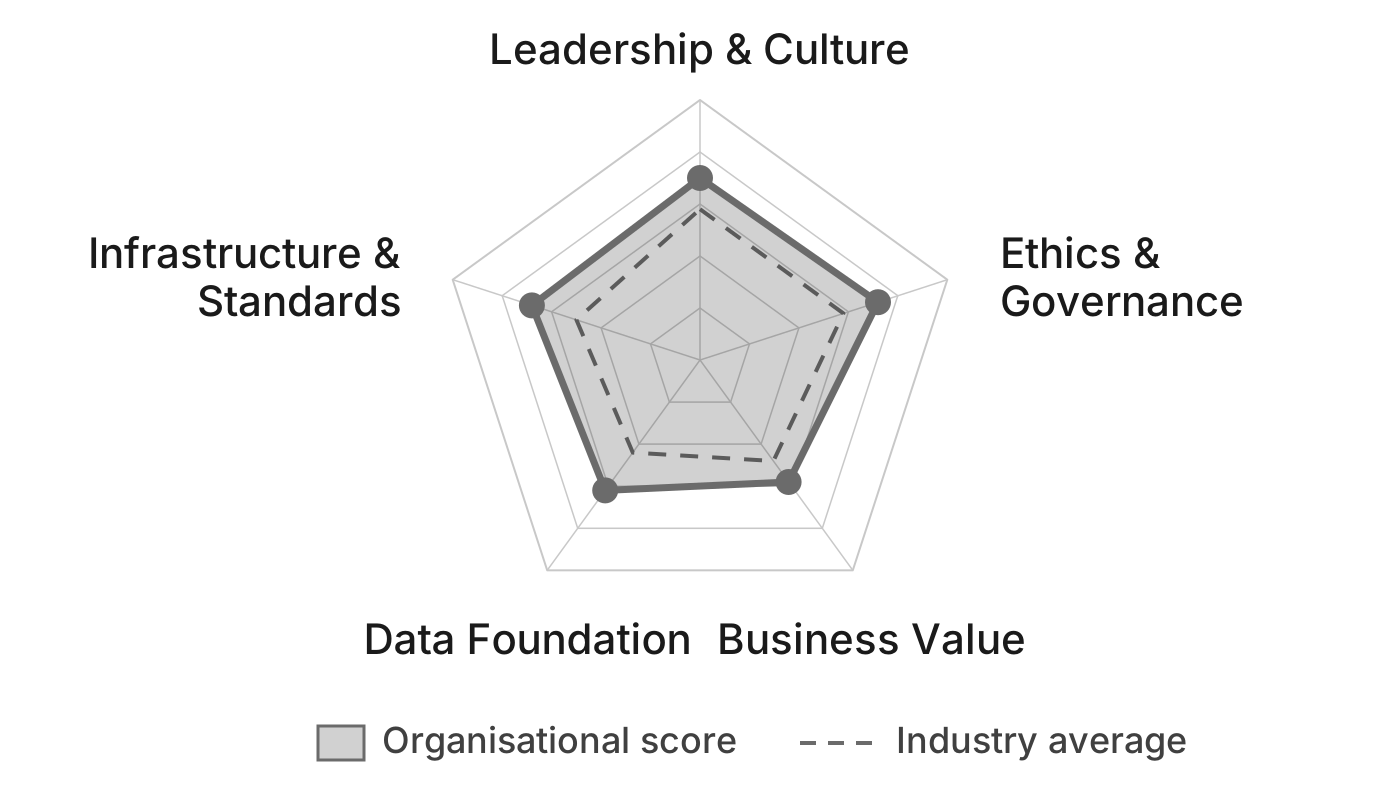
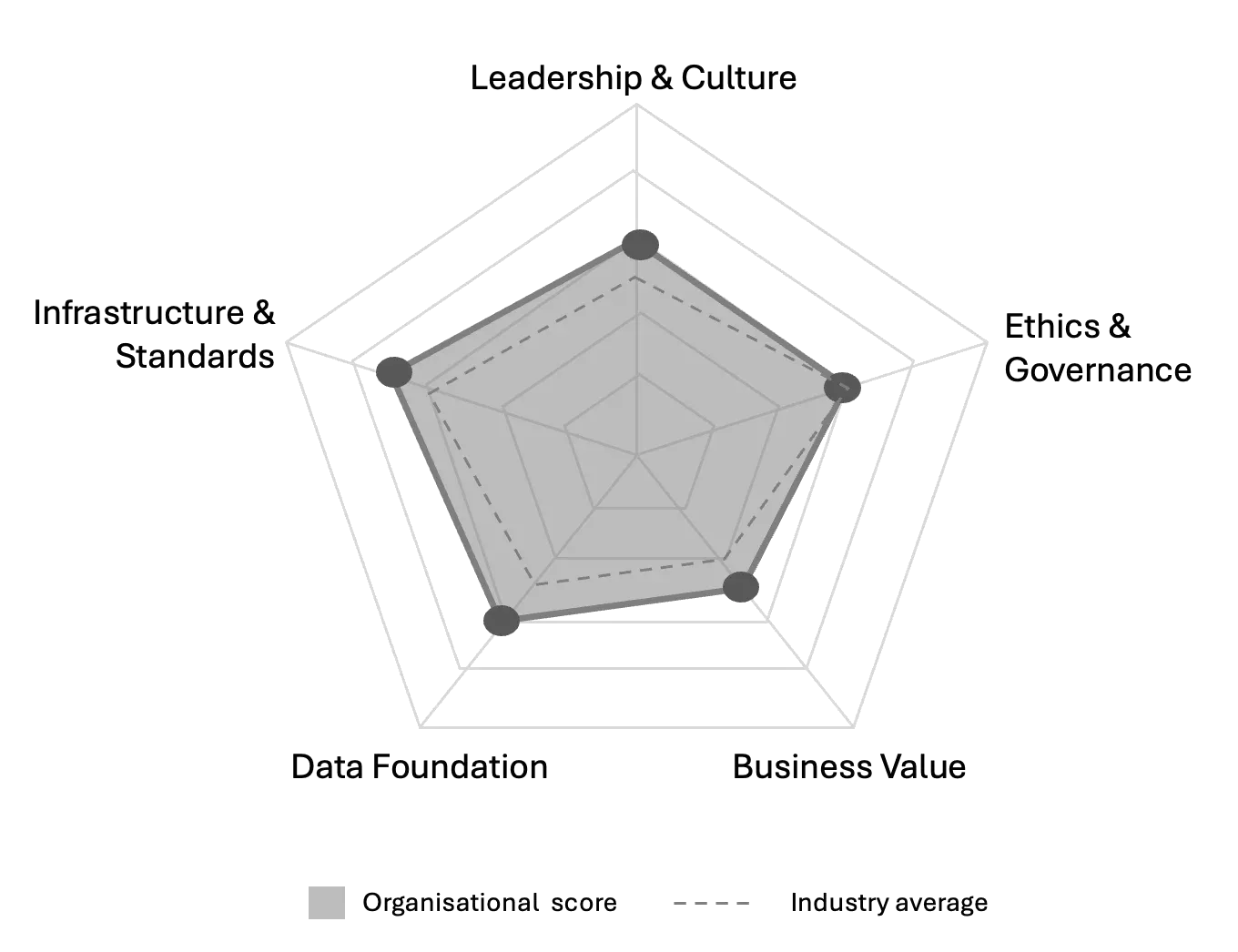
The real power of the AIRI Framework comes from using both assessments together. Aggregate pAIRI scores reveal workforce capability. oAIRI scores reveal organisational readiness. The gap between them shows deployers where individual skills outpace organisational infrastructure, or where the organisation is ready but the people are not. This alignment analysis feeds directly into the AIRI Decision Engine, which uses pillar scores to prioritise AI projects by feasibility and readiness.

An oAIRI radar chart, pillar scores plotted across the five pillars of AI readiness, with the industry average
An oAIRI profile, leadership consensus scores plotted across the five pillars.

oAIRI needs a reassessment cycle

Organisational readiness changes with leadership transitions, new data infrastructure, and policy updates. Reassess every 6 months or after major organisational changes, a fresh leadership consensus session each time.

Get the instruments

Download and deploy oAIRI

The complete oAIRI instrument (all 15 questions with behavioural anchors) is free under CC BY 4.0. Run it as a leadership consensus session in any survey tool.

Download the Instruments

Next steps

The Decision Engine

Use pillar scores to prioritise AI projects based on feasibility, value and ethics.

Explore the AIRI Decision Engine →

The AIFN Community

Learning AI is better with company.

Ask questions, share what worked, and keep pace with fellow learners.

Join the community at community.aifirstnation.org (opens in a new tab)